Scope
The aim of this project and this database is to provide comprehensive information about the mollusks living in Europe and a tool for their identification for free use.
Particular attention is paid to the completeness of the species, the quality of the information and images provided, extensive literature references and links to further information, as well as a self-explanatory identification process supported by illustrations and an extensive glossary. More details about the objectives can be found on the page About this database.
Some data about the current content and extent of the database can be found there in the section Statistics.
When you enter the database and select a class, you will first find the species listed as a taxon tree. Detailed information about the species can be found on the species pages, which can be accessed by clicking on the respective name. Alternatively, you can also display an image gallery. From there you can click on the respective picture to get to the respective species page. There you can find one or more images, an exact description, information on the distribution, if applicable information on subspecies or forms, and a reference list, containing all literature that was considered to establish this database; specific sources being recommended as further reading or containing further images are marked as such and links are provided, leading directly there.
Particular species can be found in a longer taxon tree by taxon search. Just enter genus and species names, or characteristic parts thereof. If you are not sure whether the name corresponds to the current taxonomic status, you can also include synonyms in the search. The database contains the most synonyms, in particular those used in recent literature.
Target group
This website is aimed at people interested in nature across the entire spectrum of 'scientific', i.e. at specialized scientists as well as at scientifically interested amateurs. Whether you are studying a specific group of mollusks, taking care of a collection in a museum, studying material from an excursion or just having made an interesting find, it can be a valuable support. In particular, laypersons who help with their observations to extend knowledge of biodiversity are also invited to use this tool for better validity of the data collected in this way.
Identifying mollusks
Even if this site tries to make the identification as clear and easy as possible, this cannot eliminate the fact that the identification of mollusks is no easy task at all. With certain groups, this may be even so difficult that even high-ranking scientists do not always get the correct result.
Therefore, before you start, you should consider some important tips, which you will find below in "Identifying gastropods" and "Identifying bivalves", and with regard to some technical details, it is recommended to look up the application notes.
If you still have a problem, consult also the frequently asked questions.
When you enter the database you first get to the selection plate for the classes. How to distinguish the individual classes is explained in the plate.
Identifying gastropods
For a successful use of the determination key in this database, it is important, not only for beginners, to familiarize yourself with essential terms and definitions, because even rather basic terms are not always used consistently in the literature. In such cases, it was necessary to decide on a meaning/definition for this key, usually the most commonly used one. Since it is quite possible that you are used to a different meaning, you should always pay attention to the exact definitions that are stated and illustrated for each question.
Especially with initial, essential questions, it is important for a successful identification to make a clear decision. For shells of marine gastropods, the identification process starts with the shell type, which you can select using this plate:

In particular, note the meaning of "evolut" and "convolut" (these terms are not used consistently in the literature). The distinction is made here based on whether the whorls overlap in height (at least slightly adjacent to each other) or not. Note the schematic markings in the images in this regard. The "largely involut" type is understood here as a special case of the convolut type, with a high, narrow aperture, in which the spire may also be well raised.
It is important to make a clear decision on a type here. To skip initial, essential questions or to answer them vaguely, will hardly allow a meaningful progress. If your specimen is on the borderline between two types, choose the one that seems most likely. For such species, the ambiguity is already taken into account in the database by a feature value-range, and you will stay on the right track with either decision.
The number of whorls is another example of the fact that no clear definition has been agreed upon to date. The following definition is used here:

This is largely followed in the newer literature, but unfortunately not always. Even more frequently, in older literature, the method of counting along the suture line is used, resulting in half a whorl more, which can be a problem when fractions of whorls are decisive.
In the case of freshwater and terrestrial gastropods, the initial classification is also based on morphological criteria, which in the case of freshwater gastropods also largely correlates with the families. Terrestrial gastropods comprise too many families to be included in one plate, thus the determination starst with a coarse morphological differentiation:


Here too, always pay attention to the precise definitions in the text and never allow yourself to be tempted to make a decision based solely on the similarity of an image. With freshwater gastropods, also note that the plate shown first only shows the families whose species are larger than 14 mm. Click the icon "smaller than 14 mm" to switch to the plate with the families of smaller species.
In the course of the identification process, there are also questions that require to specify a number. Always enter an integer, except for locality coordinates, which must be given with at least 2 decimal places.
When all questions have been answered (or skipped) and there is more than one species left, the identification process switches to the pairwise comparison mode, where you can successively rule out further species. Again, pay attention to the specific criteria for differentiation given after the description of each species and do not decide solely by the images. If both species shown do not apply, just rule out one of them, preferably the one that applies the least.
To the Identification key for marine gastropods
To the Identification key for freshwater gastropods
To the Identification key for terrestrial gastropods
Identifying bivalves
For a successful use of the determination key in this database, it is important to familiarize yourself with essential terms and definitions. For the identification of marine bivalves, in particular, those who are less experienced should first study the different types of hinges, in order to be able to make the first important decision correctly. The genera shown in the plate below are only examples and there are many more genera of the respective hinge type:

To investigate the hinge type, it is unavoidable to open the valves. Even if the hinge is well preserved, the recognition of the type is not always easy and requires a careful look. A heterodont hinge, for example, is often poorly developed or even rudimentary. Deciding whether an external or internal ligament is present is also often not easy, as it is often not preserved in single valves. The attachment-scars -grooves or -pits, must therefore also be taken into account, but these are sometimes not easy to recognize. This requires a certain amount of practice and sometimes it may be necessary to follow both paths.
Further differentiation is based on external morphological criteria, such as the following for the taxodont and heterodont hinge type with external ligament:


Again, note the textual definitions, as the illustrations are only examples to support the understanding. The species of each type may look very different.
To the Identification key for marine bivalves
To the Identification key for freshwater bivalves
Identifying polyplacophora
First, you should make yourself familiar with the terms used in this key. They are explained in a plate in the glossary. Click any term to go to the glossary.


The most important key element in the determination of polyplacophora is the sculpture of the middle valves, which you should carefully study under the microscope or in a high resolution image.
To the Identification key for polyplacophora
Other classes
To the Identification key for scaphopoda
To the Identification key for monoplacophora
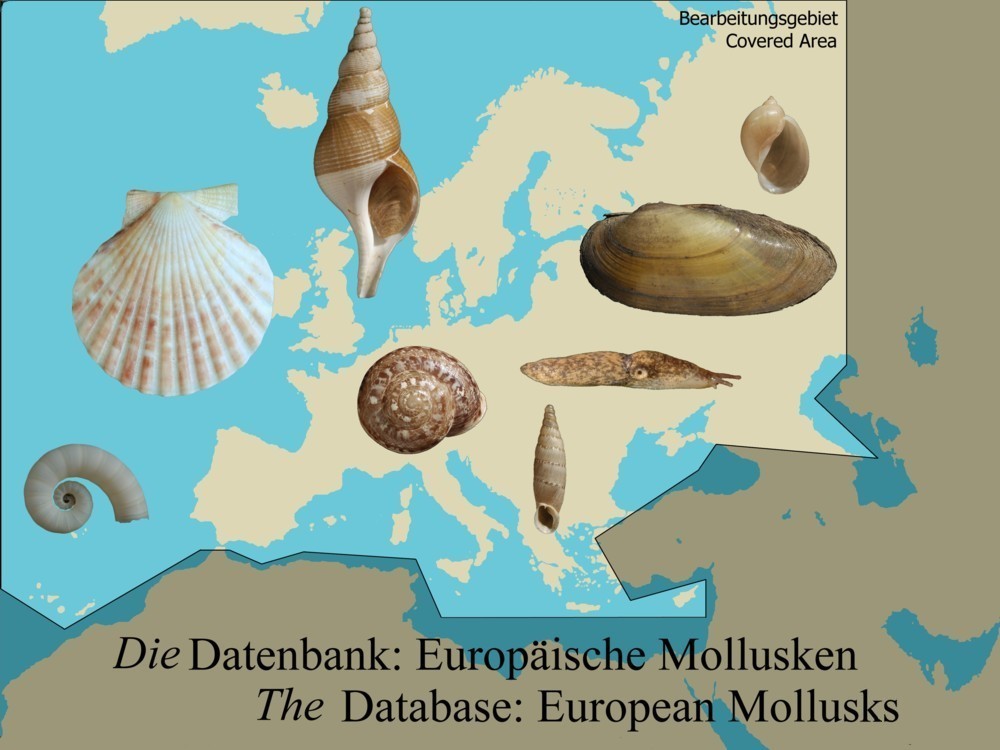
Covered area
The covered area is already shown schematically in the image above.
More details can be found on the "About this database" page in the section Covered area.
Orientation
The systematic arrangement in this database is largely based on that of Molluscabase.
Deviations from this are always explained. For more details look up "About this database", section Orientation.
Acknowledgments
Many thanks go to the numerous colleagues and institutions without whose support this website would not have been possible in this quality.
All names are listed on the page Acknowledgments.